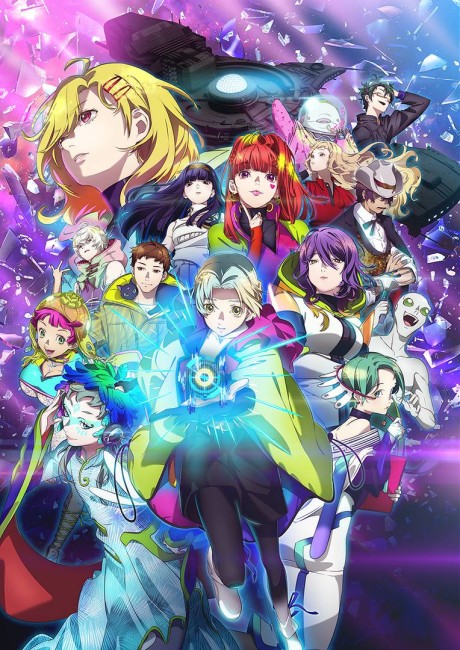



This past fall, the anime community had the good fortune to receive Gnosia (pronounced [guh-NO-see-uh]), a science fiction thriller anime based on the 2019 game of the same name. Never in a million years would I have expected to encounter such a self-assured, eccentric science-fiction universe as this one. It is an anime that does not hold back from charging forth to the limits of imagination regarding humanity’s far future, and it categorically rejects any sense of normality.
Gnosia, the game, is a social deduction game in the vein of Mafia, Are You a Werewolf, or Among Us. The key difference is that Gnosia is single-player. The game works by incorporating visual novel elements, rudimentary AIs that base their choices on hidden suspicion and trust values, and transforming the cyclical nature of the game into a mechanic and narrative device itself. Thus, indie dev team Petit Depotto recreated a genre normally locked away from solitary audiences with genuine brilliance.
The anime sought to recreate this unique experience in a stricter narrative format. Supported by Petit Depotto and produced by indie animation studio Domerica, Gnosia’s anime covers all the relevant aspects of its deeply uncanny setting. It is surprisingly faithful. Audiences received an atypical 21 episodes with striking visuals and high production values.
While I will not use the anime’s status as an “adaptation” to evaluate it—as I believe in holding art up on its own independent merits—discussing Gnosia requires talking about how the game presented itself to properly discuss how it presents those same elements to anime viewers.
In Gnosia, players hop aboard the D.Q.O, a galactic ship currently on lockdown after evacuating a planet infected by “the Gnosia,” former humans infected with a pseudo-psychological virus. The Gnosia lie compulsively and await their chance to terminate all humans aboard. To save themselves, the remaining humans need to correctly identify the Gnosia among them and put them into cold sleep. Otherwise, the ship’s onboard AI, LeVi, will self-destruct the ship to prevent the infection from reaching other colonies.
There are numerous roles you can fulfill that map neatly onto traditional social deduction roles. Aside from the Gnosia, Engineers investigate a person to determine if they are human or not. Doctors verify whether cold-slept passengers were human. Guardian Angels protect one person from attack at night. Two members of Guard Duty are guaranteed humans. The Anti-Cosmic (AC) Follower is a human who wants the Gnosia to win and disrupts deductive logic. Lastly, the ethereal “Bug” wins by surviving to the end.
The anime adopts almost all of these roles wholesale, and I have mixed feelings on that decision. The explicit gamification of the roles is fun, but also incredibly disruptive given the opportunities an adaptation provides. A bad usage of gamification is the way LeVi handles the Engineer and Doctor roles, assigning them seemingly at random after the infection begins. Why don’t people already know their credentials before coming aboard? One or two additional lines could justify why this is a “role” to begin with.
Even worse is the Guardian Angel, the existence of which prompts unanswered questions. What is the Guardian Angel doing in-universe? LeVi could offhandedly mention that they can reroute power, shielding one passenger’s room according to the designated Angel’s wishes. Guard Duty is meaningfully reproduced because it is a logically self-selecting role, and the AC Follower is featured briefly. The only role the anime handles meaningfully is the Bug, fulfilled as a narrative role by one character.
I dislike that Gnosia is so reliant on maintaining the overt game of Werewolf they are all playing, rather than expressing subtlety. Domerica proved they were willing to make anti-gamification changes in other areas; LeVi evaluates the ship after every cold sleep using the ship’s lighting as a pass/fail indicator. Why couldn’t this same creativity be applied to core social deduction roles?
As for adapting the rest of the game, the story focuses on the Silver Key, a hungry knowledge-hunting device that sends the player back to the beginning via hundreds of time loops. These loops alter the foundational situation of the D.Q.O.
Critically, through these loops, we see the 14 possible survivors: stoic military operative Setsu, obnoxious yet charming SQ, Shigemichi, a prime candidate for Area 51, Chipie, who wants to become a cat, an intellectualized dolphin named Otome, mysterious Kukrushka, the technically insane captain Jonas, Yuriko, a fugitive priestess, and several others. Gnosia is speculative science fiction set thousands of years in the far future, introducing concepts like cryogenics, multiverse theory, digital consciousness, organic body modifications, animal intellectualization, and extradimensional spacetime.
In contrast, the boundless possibilities of Gnosia’s world enable something I did not expect: openly asexual and non-binary characters. The anime adaptation did not skimp on including these facts, primarily for Setsu and Raqio. Setsu explicitly reminds others multiple times that they are decidedly “not a woman.”
For the adaptation, Petit Depotto created Yuri to serve as the main protagonist. Yuri is a fantastic stand-in for the player role, lacking enough background to plausibly take over the empty nameplate while having enough personality to act out necessary tensions. They made a person out of a PC.
As for other characters, the show covers them all, though unfortunately not equally. Primary deuteragonist Setsu is the main focal point alongside Yuri. Toward the middle, the show does full loops dedicated to Gina, SQ, Sha-Ming, and Comet. However, characters like Otome and Remnan are completely underserved, existing only to give Yuri insight.
Aesthetically, the anime is fantastic. The Gnosia were adapted near-perfectly, transforming scenes into light horror. The music is amazing—”Bake no Kawa” is a fantastic Opening—and the inclusion of game sound effects preserved the distinctive sci-fi formula.
Verdict – Is Gnosia Worth Watching?
Gnosia did not need to exist, but I am glad it did. While not flawless, its sheer uniqueness makes it a complete experience—one faithful to its origins, intentions, and potential. I quite enjoyed the anime and it did not disappoint in the least.
Gnosia Anime Review
Gnosia-
Animation92/100 Amazing
-
Story and Pacing88/100 Amazing
-
Soundtrack94/100 Amazing
The Good
- Unique Plot
- Amazing Soundtrack
- Engaging Characters
- High Quality Adaptation