



Whenever I was playing Zero Parades: For Dead Spies, I couldn’t shake the feeling that it was anything other than a Disco Elysium sequel. The shadow of the artistic brilliance as well as its IP debacle and the subsequent fallout at ZA/UM loomed over each nook and cranny of Zero Parades. It is in no way a jab at the merit of Zero Parades. By all metrics, ZA/UM’s latest espionage thriller/meloncholy simulator is an excellent game and encompasses many of the things that made its predecessor a sleeper hit. Being one of the first outlets in the world who got to check out Disco Elysium early, we knew that it was going to be a game-changer, and Zero Parades strikes similar chords. Despite the unfortunate circumstance the developer has found itself in, the game they made deserves all the praise it’s getting. But make no mistake, Zero Parades borders on the edge between a sequel and a spiritual successor. Whether that’s a good thing or not, that’s for you to decide. Zero Parades kept me so hooked that I found myself coming back to it even amidst my own wedding preparations.
Only Guts
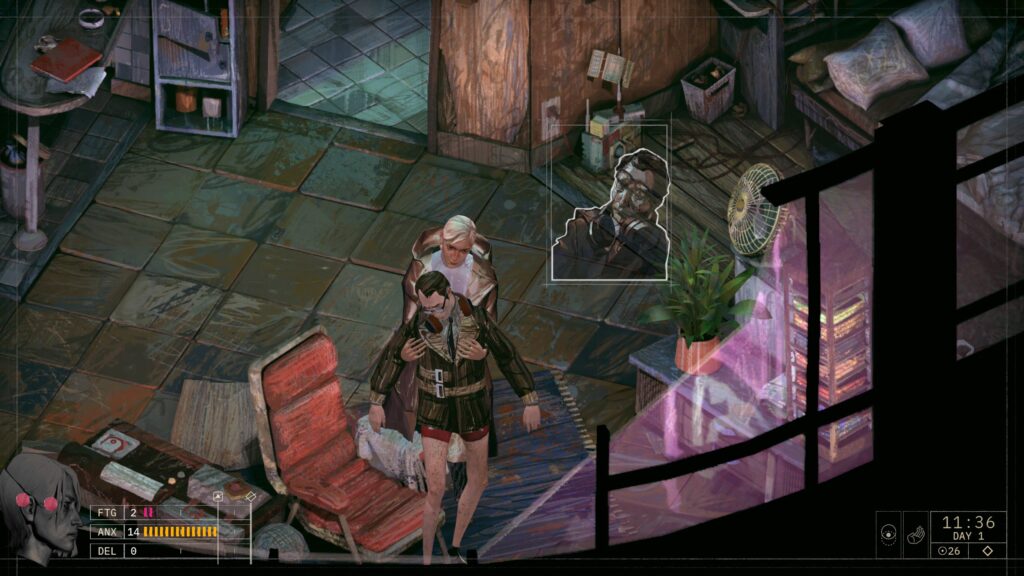
Like its predecessor before it, Zero Parades is a verbose CRPG with an emphasis on dialogue choices and dice-roll-driven skill checks, mimicking an espionage thriller. Spy thrillers are some of the most overused tropes in movies and literature, resulting in decades of stereotypes and glorifications. When it comes to video games, spy thrillers are kind of a rare thing, if you discount the many Bond adaptations. Alpha Protocol is perhaps the closest we got to an all-encompassing spy thriller, but that too relied on tropes and cinematic moments. Zero Parades strips the genre of all the glamour to tell a grounded story. There are no larger-than-life agents, no practically impossible gadgets, and no over-the-top action. Zero Parades is a boots-on-the-ground investigation in a dying culture filled with broken people.
Disco Elysium navigated the paradox of producing radical critique within a global market economy. By embedding ideological struggle into mechanics rather than merely narrative, it transformed political discourse into lived player experience. Zero Parades tries something similar. But the difference here is that it’s primarily a deconstructive espionage thriller with a strong focus on geopolitics. Here, players control Hershel, a once-legendary “operant” codenamed CASCADE, who gets back into the game after being in “the freezer” for five long years. After leading her teammates into disaster during a failed operation, CASCADE’s mind has become fractured and unstable. In a similar “Harry” situation, her instincts speak to her internally, functioning as competing voices and personalities. The crux of the game has a broken CASCADE on a mysterious espionage mission on her own (for the most part). Waking up in a dirty apartment with less-than-stellar memory and an indisposed partner, it’s up to CASCADE and the player to navigate the decaying world of Portofiro.
Shadow of the World
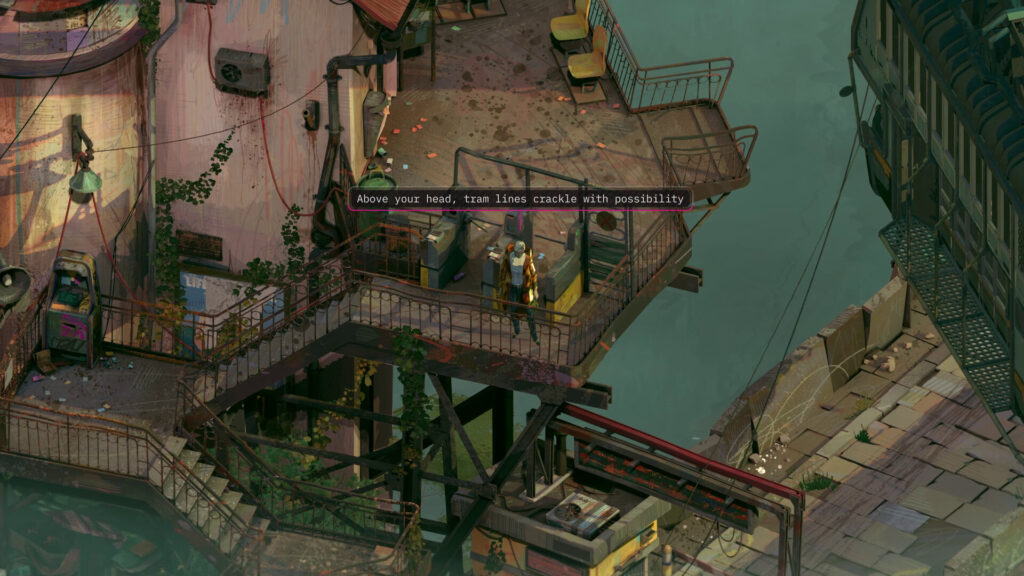
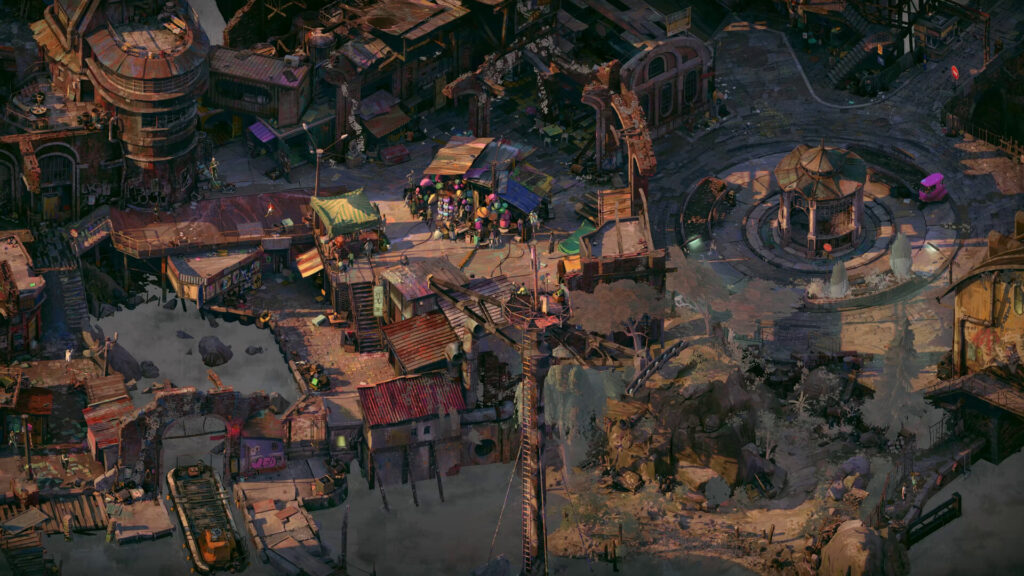
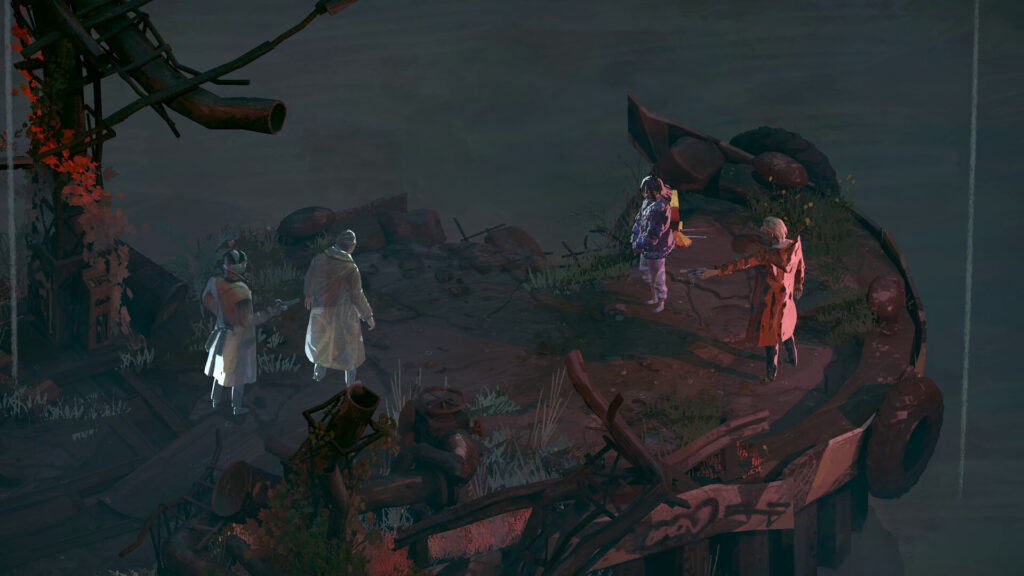
Portofiro is the heart and soul of Zero Parades, a sprawling urban jungle caught in a three-way struggle for political and cultural dominance. ZA/UM describes the city as set at the “End of History.” Similar to Numenera, Portofiro is a place stuck in time where numerous political, cultural, and ideological centers have risen up and collapsed; where history feels frozen; and where spywork is the secret cog that gets the machinery running. The city itself is a frantic representation of a mad artist’s psyche, inhabited by techno-fascists, propagandists, manipulators, and extremists hailing from different walks of life. Zero Parades’ fantastic graphic novel-inspired artwork does wonders to bring a touch of noir to this broken city and its population.
A Bit Close to Comfort?
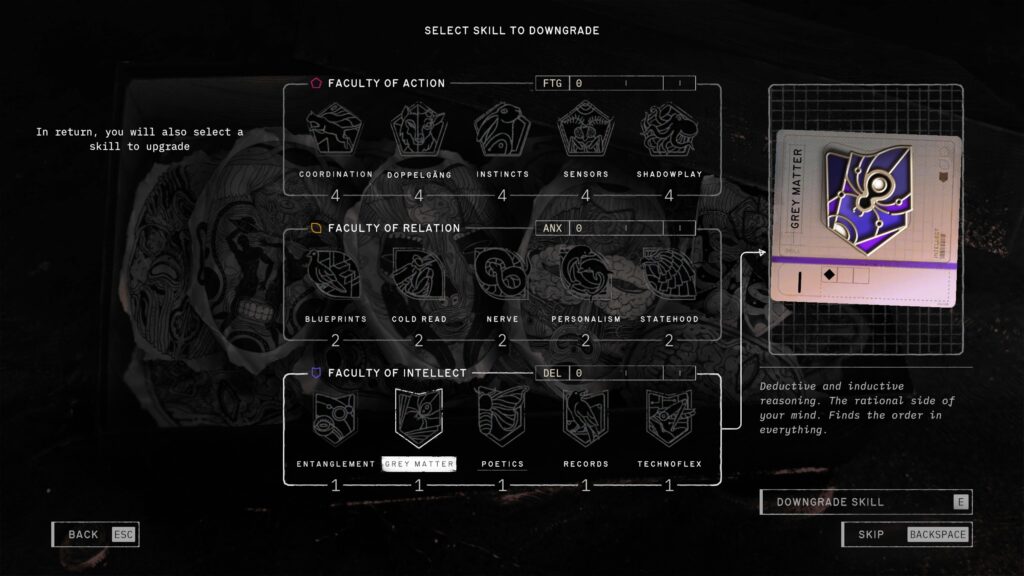
While Zero Parades’ setting does its best to distinguish itself from Disco Elysium, the gameplay side of things does not. It is, at heart, a dice-roll-powered, choice-driven CRPG where failure is often more interesting than passing skill checks. CASCADE’s attributes are divided into three groups: faculty of action, faculty of relation, and faculty of intellect, each corresponding to physical prowess, stealth, and intellect, respectively. These are further supplemented by five skills each, a streamlined version of the skill chart from Disco. Action-based abilities are tied to a Fatigue meter, while Relation-oriented skills revolve around social interaction and influence Anxiety. Intellect skills deal with cognition and perception, affecting Delusion. Dialogue choices can raise or reduce these conditions. Completing checks and advancing through the narrative rewards experience points, which can then be spent to strengthen whichever abilities you want to specialize in.
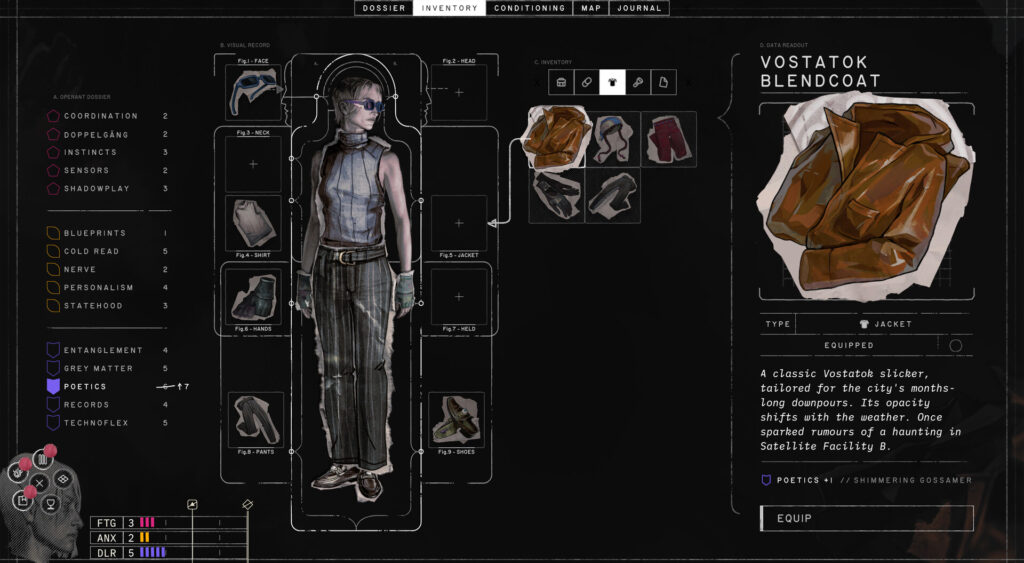
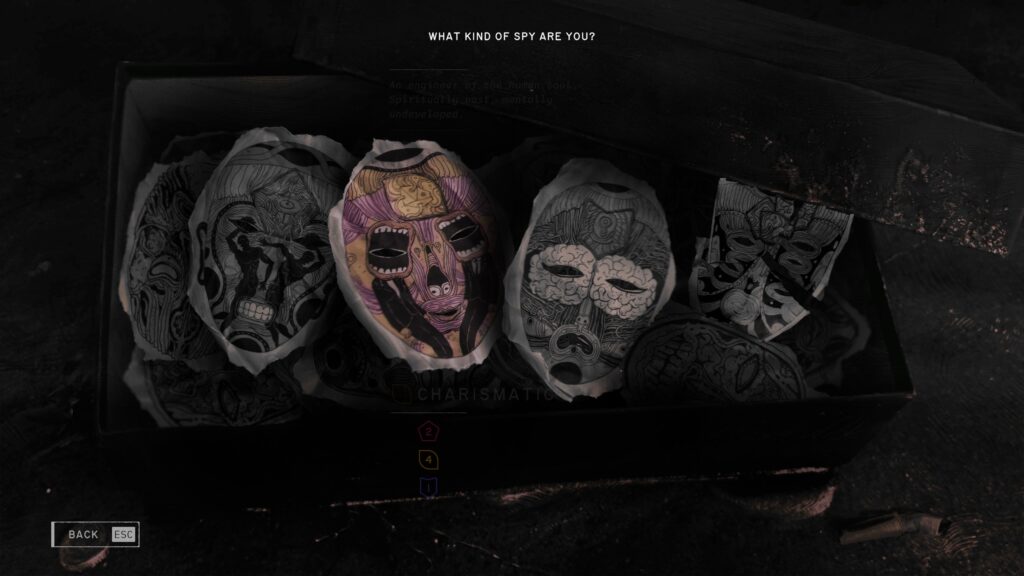
While Disco Elysium revolved around the question, “What kind of cop are you?” Zero Parades instead asks what sort of operative CASCADE will become. Every decision feeds into that identity, with the game constantly responding to your behavior and adapting to the path you carve out. Most missions can be tackled in several different ways, encouraging experimentation rather than forcing a single solution. Your interactions gradually define Herschel Wilk not just as a spy but as a person. The game’s Conditioning system serves a role similar to Disco’s Thought Cabinet, allowing CASCADE to absorb ideas, psychological tendencies, and strange compulsions that unlock new traits, bonuses, and drawbacks. Equipment also plays a larger role than simple stat boosts; clothing and accessories influence both CASCADE’s perception of reality and the way others perceive and judge her. Mechanically, Zero Parades feels extremely close to Disco Elysium, from its dialogue-driven progression to its skill-heavy role-playing systems. Personally, that’s hardly a complaint. More games could stand to embrace a little of Disco’s spirit.
A Few Loose Ends
There are a few technical hiccups in the form of minor bugs and less-than-stellar performance on the Steam Deck. The voice acting is a bit of a hit or miss. While it’s generally fine, the voice actor for the narrator takes a bit of time to get used to. The fact that Disco had an immaculate narrator may have something to do with this. The voices managed to distinguish themselves from each other, giving Harry’s fractured psyche multiple dimensions. Here, the voice actor sounds like she’s trying too hard to mimic the style of Lenval Brown. Similar to vanilla Disco, the game is partially voice-acted, which is not a problem because I love reading, and a future director’s cut patch could add full VA. The music, too, is not great all the time and is serviceable at best.
Real Talk
Even beneath the enormous shadow cast by Disco Elysium, Zero Parades: For Dead Spies succeeds in delivering an engrossing espionage narrative that can stand alongside its obvious inspiration. Although the game occasionally struggles to step out from Disco’s influence, its exceptional writing, distinct yet familiar atmosphere, and striking visual direction prevent it from feeling like a hollow copy. Lightning rarely strikes the same place twice, but Zero Parades still manages to capture some of that electricity, even if its spark burns within a slightly smaller vessel.
FINAL SCORE: 87/100
Zero Parades: For Dead Spies Review
From the creators of Disco Elysium comes ZERO PARADES – an espionage RPG. You're a brilliant but tormented operant on one final desperate assignment. Gather your broken network, untangle a web of lies, and prove yourself on the world stage - or blow it all up again.
Price: $39.99
Price Currency: USD
Operating System: Windows
Application Category: Video Game
8.7