



In this day and age of AAA titles, a very select number of studios are willing to risk making a product that pushes their audience to their limits. Single-player games in general have gotten much easier to finish if you look at the mainstream PlayStation titles. However, they took a bold gamble with releases like Demon’s Souls and Housemarque’s Returnal. Less than 20% of players have finished the latter, making its sequel, Saros, probably one of the biggest risks the mainstream giant has taken in years. Result? One of the most refined and unique shooters ever made has created a cult following of its own.
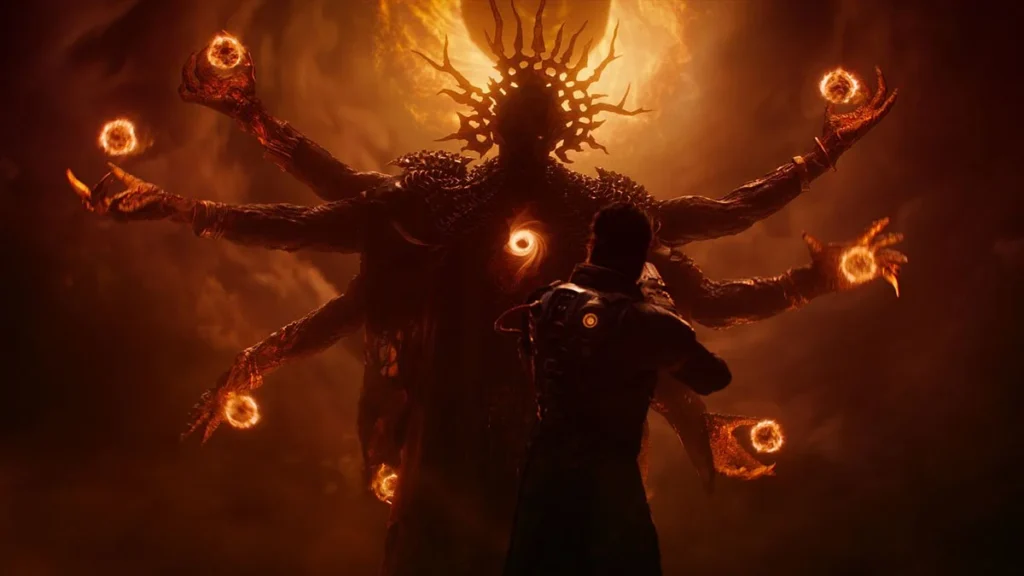
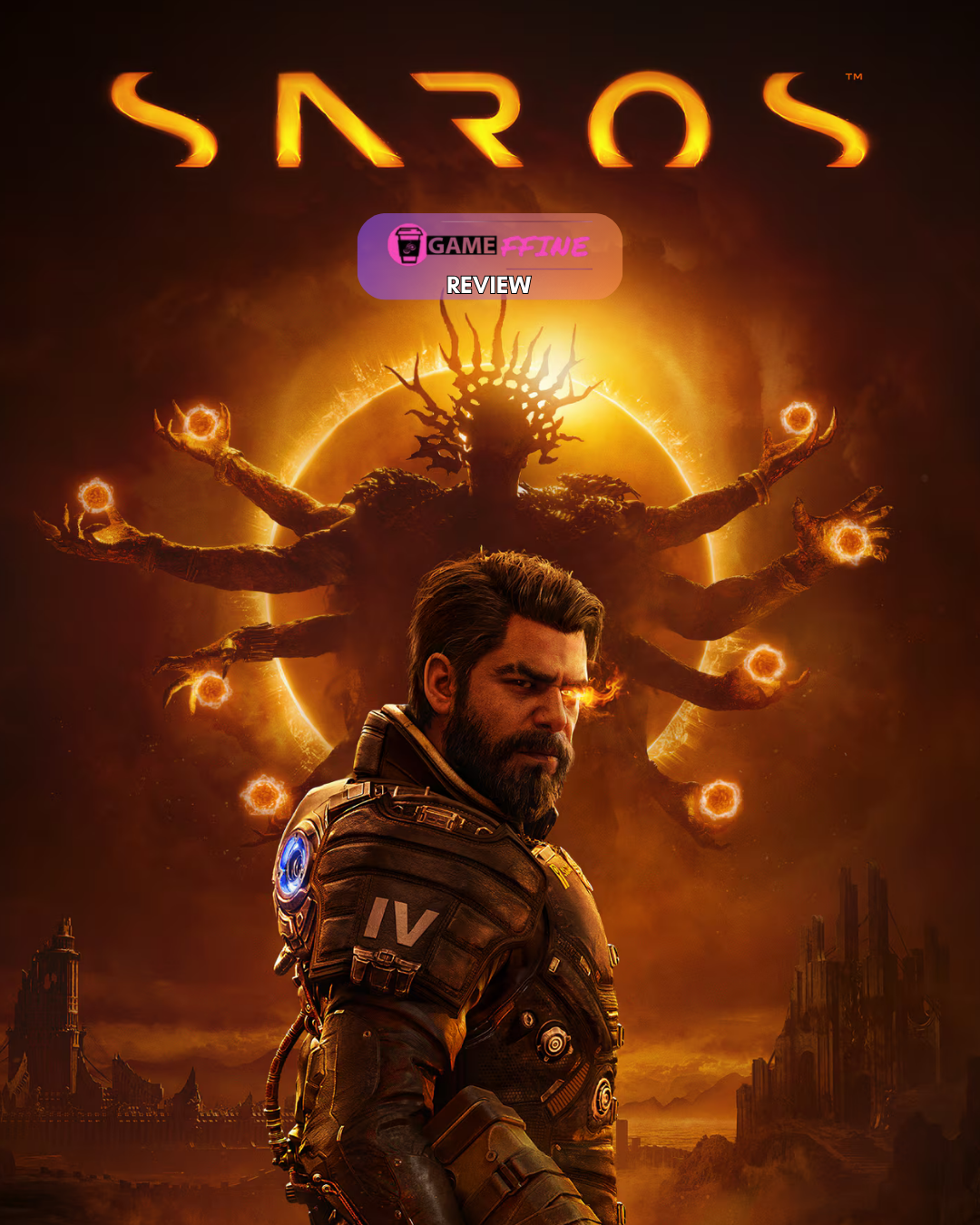
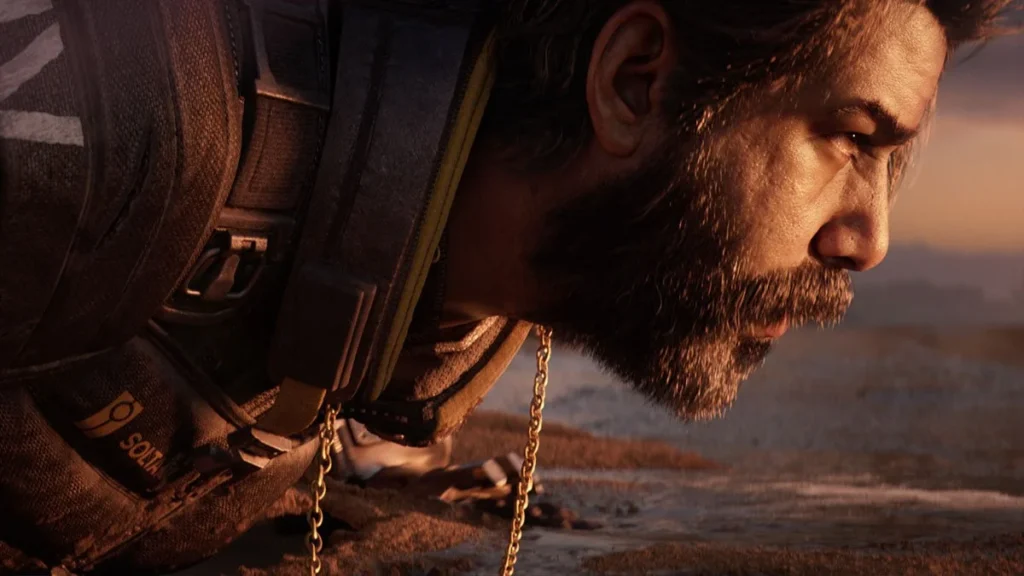
Saros is a third-person sci-fi roguelite video game released exclusively for the PlayStation 5 on April 30, 2026. It tells a twisted tale of Arjun Devraj (voiced by and modeled after Rahul Kohli), an enforcer from Solatori— a Weyland-Yutani-esque megacorporation—sent to investigate the shape-shifting, hostile alien planet of Carcosa.
Carcossian Conundrum
Saros kicks off cryptically, with Arjun waking up alone and disoriented on Carcosa, throwing players straight into the action, much like Returnal, without lengthy opening cutscenes. Lucinite? Soltari? Nitya? Echelon IV? And what became of the other three Echelon teams? The game reveals most answers through its gameplay and environmental storytelling. At first, nothing makes sense, but after multiple runs, the pieces start to fit together—how Soltari is mining Lucinite and attempting to colonize the untamable world of Carcosa; how Arjun is stuck in a loop of his own, searching for his missing wife, Nitya, an ecologist from the Echelon 1 team with most of its members either missing or dead, as well as the strange way time flows on Carcosa and it transforms under a solar eclipse.
The story dives into the perils of exploiting the environment, with the Solitari viewing Carcosa purely as a resource, a mindset that ultimately leads to their downfall. It also explores the mental strain of isolation on an alien world, sparking delusion and distrust among the crew. At its core, though, it’s about Arjun’s relentless quest to find his wife, Nitia, no matter the personal cost—a journey wrapped in themes of attachment, sacrifice, and the longing for redemption. All of this unfolds against a backdrop of time distortions tied to a Lovecraftian, tentacled presence, pushing the player to question what’s real and what’s a trick of the mind or the cosmos.
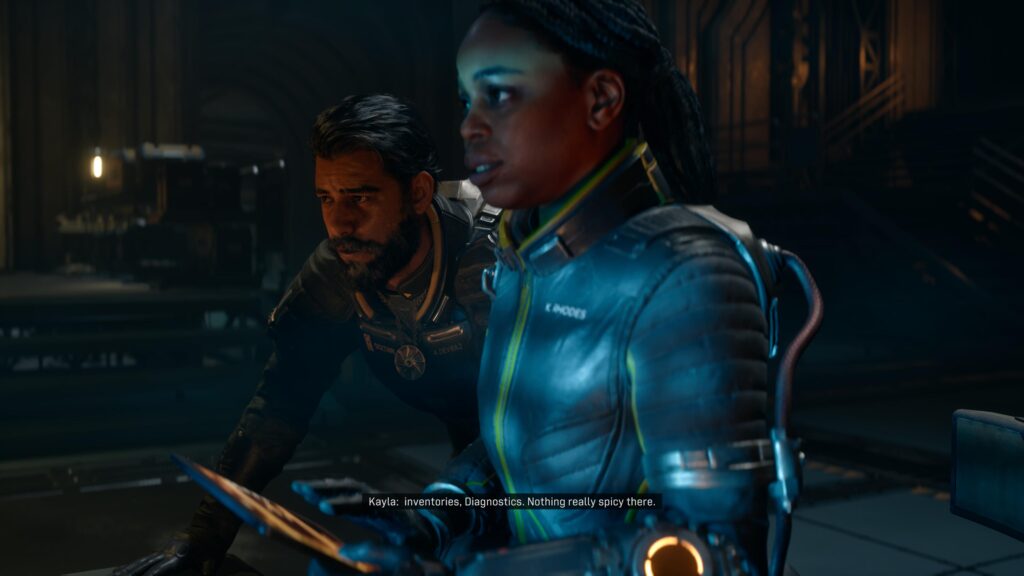
If you’ve finished Returnal and experienced its true ending, you can expect a similar impact when reaching the actual ending of Saros. The story offers multiple endings, including a true one, but whether you’ll like it or not is entirely subjective—you’ll either love it or hate it. Still, it leaves a lasting impression that lingers in your memory. Its 30-hour campaign is truly remakeable. Considering how it captivates the audience through environmental storytelling and surreal flashback sequences of the banyan tree that delve into Arjun’s past life, Housemarque deserves strong credit for its unique style of delivery. Rahul Kohli’s portrayal of Arjun Devraj is easily one of the standout performances of the year. My only minor gripe is that the other crew members could have had more screen time, even if it slightly diminished the feeling of isolation.
Bullet Hell, Heaven Sent
While Saros may not have the wow factor of Returnal, with its genre-defining bullet-hell mechanics and fast-paced gunplay that demanded impeccable precision and finely tuned muscle memory to master, it offers something even more valuable – accessibility for players without diluting the challenge or the fulfillment of reaching the end. Returnal is one of the most challenging games, where you start from scratch after each death. Since less than 20% of people managed to finish Returnal, Saros adds a permanent skill tree where you spend resources like Lucinite and Halycon collected during your last run—coming back stronger after each death. Still, to ensure the challenge is not diluted, Saros makes it harder for you to heal as compared to Returnal, as you can no longer carry healing consumables. Also, the upgrades that you can unlock are capped based on the Overlords that you have defeated.
In addition, some modifiers can make the experience both more difficult and easier at the same time. However, you can’t enable every single protection, as it weakens the modifier gauge system. -3 is the lowest setting the game allows, with 0 as the default. If you’re looking for a challenge, you can max out your gauge by enabling every single handicap, like taking more damage or facing deadlier enemies. Overall, it can make the game slightly easier but still considerably challenging, even at its lowest. This feels like the perfect balance for those who quit Returnal early on.
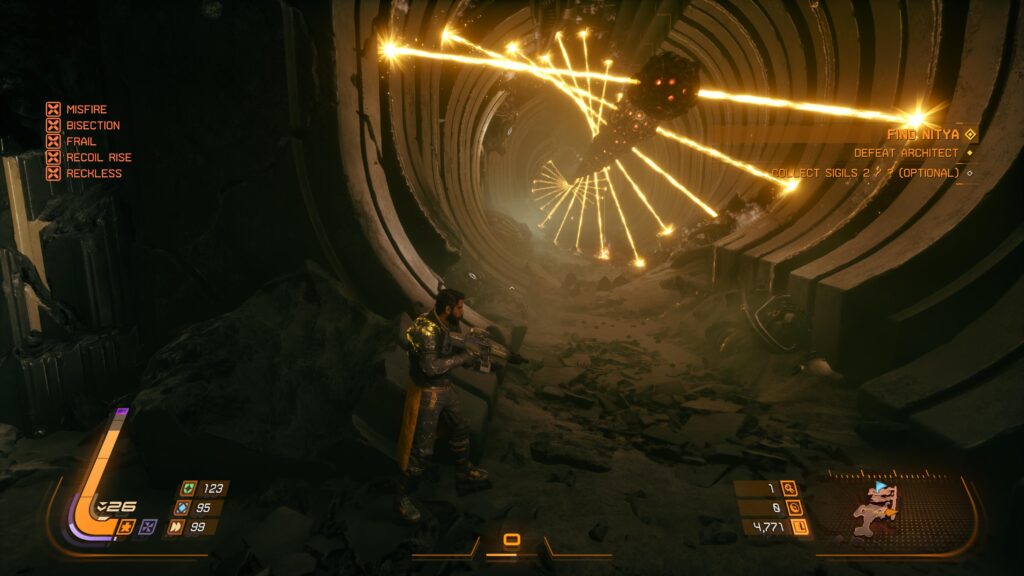
When it comes to bullet-hell gameplay, Saros feels like a major upgrade from Returnal in almost every way. The gunplay and movement are smoother, more responsive, and simply more fun. Enemy projectiles are clearly color-coded—blue can be absorbed with your shield, yellow can be phased through with a dash, and red can be parried, which is incredibly satisfying. You can even tweak the default color scheme to your liking. The biomes feel more alive than ever, and when the eclipse is invoked, the transformation is surreal, turning the terrain twice as deadly as its overlord stirs from its slumber.
The level design feels a lot like Returnal’s, but things switch up when you trigger the eclipse using the eclipse device. You start each biome along the main path, tackling most side routes to boost your weapon proficiency and three core attributes—resilience, command, and drive. As you level up, you can grab weapons with higher proficiency, though I mostly stuck with the Smart Rifle for its wide auto-aim and ability to hit multiple enemies at once. It’s great for crowd control when you’re swarmed with projectiles from every direction, and matching the horde’s chaos is key to survival. Unlocking the second chance skill seriously improves your shot at reaching the overlord. But if you lose a life along the way, you can gamble your remaining life in the Nightmare Strand, packed with tougher enemies. Win there, and you gain an extra life—lose, and you’re sent back to the passage.
Spectacle of the Lords
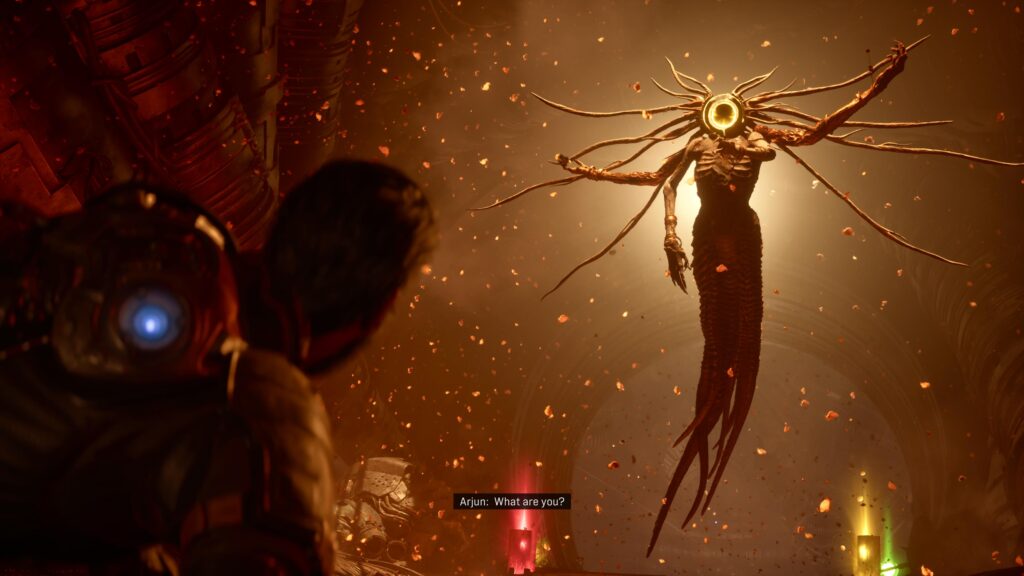
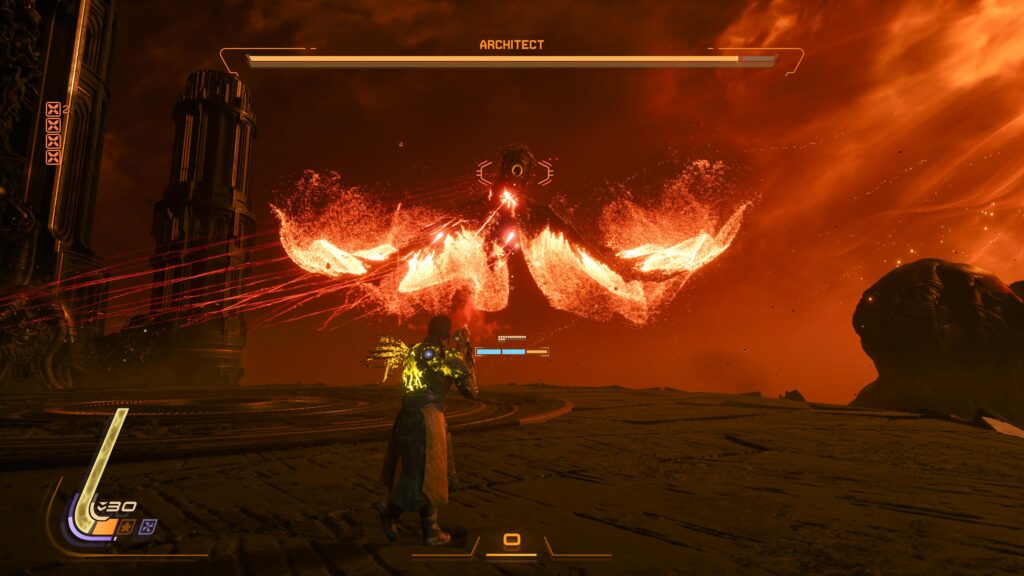
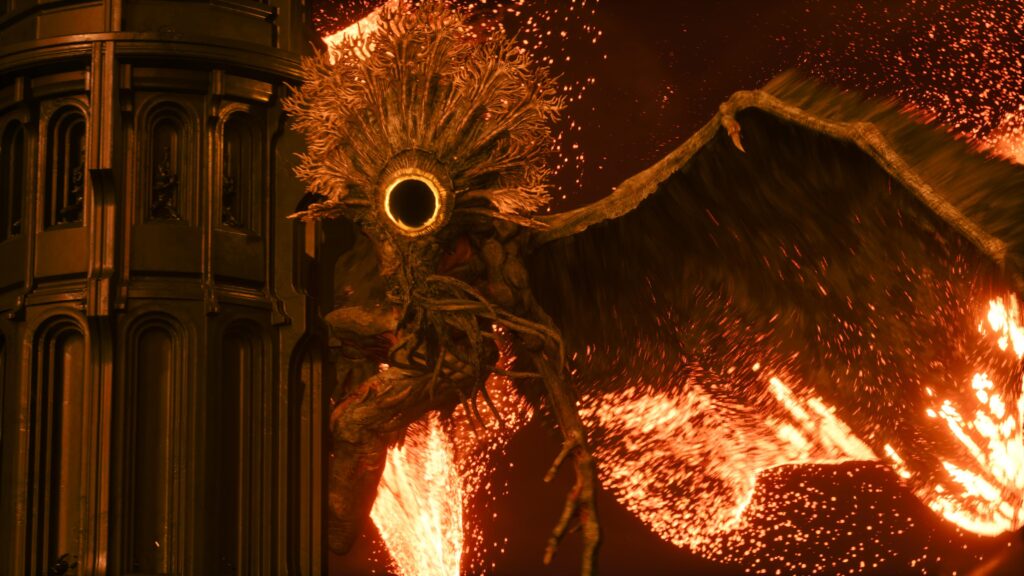
Once you reach an Overlord, the feeling is eerie, as their design is simply too outworldly – beautiful and terrifying at the same time. Their attack patterns are rhythmic and almost all of them have at least three full health bars. The first Overlord – The Prophet- can be quite tricky if you are new to this genre. Later bosses, until a certain point, are somewhat easier as you unlock more abilities and ways to traverse. The feeling of facing triumphs most of the boss battles that I have seen in any Soulslike game.
The visuals and sound blend seamlessly, with Saros managing to surpass even Returnal’s renowned audio design. If you own an accessory like the Pulse 3D headset, now’s the perfect time to use it—its 3D audio is unlike anything the PS5 has experienced so far. Impressively, the game runs on UE5, an engine often criticized for poor performance on current-gen hardware, yet thanks to Housemarque’s in-house optimizations, Saros delivers a sharp 1250p resolution on the base PS5 without sacrificing visual quality. It maintains a smooth 60fps, with only minor hiccups in certain biomes, and a 120Hz mode at 1080p for Pro consoles seems like a realistic addition in a future update.
Real Talk
Saros is an incredible game that follows in the footsteps of Returnal and manages to surpass it in almost every single aspect strikes the right balance at keeping things fresh in every cycle, despite multiple runs. While some Returnal purists may not like its permanent upgrade system and in-game modifiers, there is enough content to push anyone to their limits. Its narrative and themes are heavy, leaving a lasting impression on those who make it to the end.
FINAL SCORE: 93/100
Saros
SarosThe Good
- Impeccable Gunplay and Movement System
- The Narrative and Themes
- Level Design and Eclipse System
- Overlord Battles are a Spectacle
- Accessibility Options - Permanent Upgrades and Modifiers
- 3D Audio Sound Design and Visuals
The Bad
- Missing 120hz mode
- Weapons with Auto-Aim like Smart Rifle and Crossbow Feel Fare Much Than Short Range Weapons like Shotgun
- Upgrade System May Not Cater to Returnal Purists