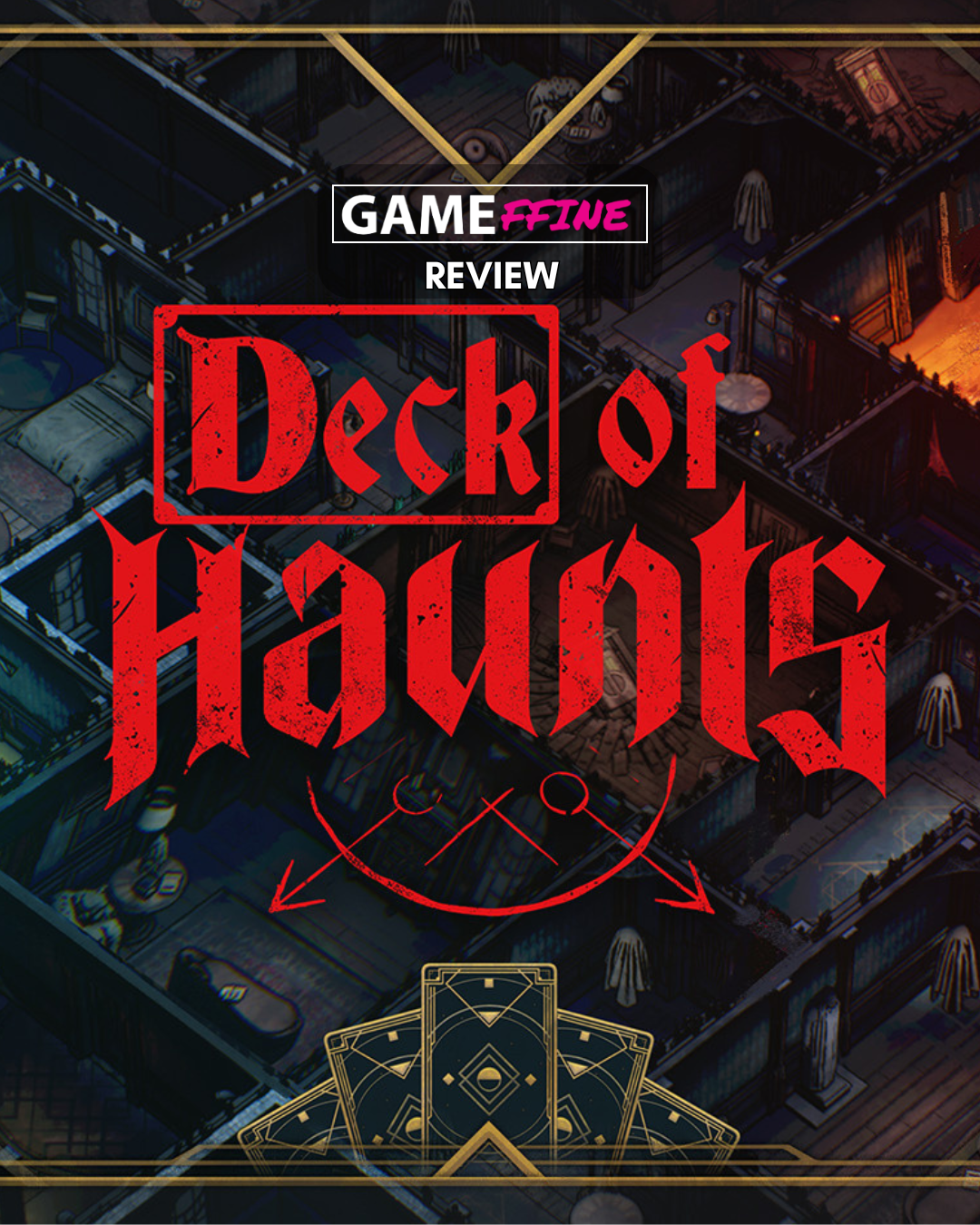




Slay the Spire was one of the first roguelites that came out with a card-focused narrative. The game was like an endless scaling of levels, and with each level, a random thing can happen – maybe the player has to face an enemy or a mini-boss, solve a quiz, or simply take a whiff in a coin toss. The player levels up with each encounter, facing a boss at the end of that stage, and then moves on to the next. There have been many spin-offs of this with the focus on the card-based gameplay – each has its own unique twist to cater to the market. Deck of Haunts is a particularly spook-tacular card-based roguelite that came out recently. Being a card game fanatic myself, I found myself being drawn to it pretty quickly.
Deck of Haunts came out on May 7, 2025. The game was developed by Mantis Games and published by DANGEN Entertainment. The game is currently available on PC via Steam, and will launch for consoles later this year.
Deck of Haunts puts the player in the boots of a powerful entity in charge of a haunted villa, and they need to scare away any daring trespassers or outright send them to the afterlife (maybe then they’ll have some sympathy for a demonic entity’s privacy, the bastards! ).
The game uses a card-play mechanic that allows the player to achieve this objective. Most of the cards either damage a human or reduce their sanity. Once either the health or sanity of a human reaches zero, they will no longer be an issue to the great Beelzebub. With each successful encounter, the player needs to add cards to their “deck of haunts” and come up with creative ways to kill humans or scare them into submission. Killing or spooking humans also grants a weird spectral resource that allows for the conjuration of more “fake” rooms for the humans to wander around in.
The idea is that the entity’s heart is placed inside the villa, and that needs to be guarded at all costs. If a certain number of humans see the heart, the game ends in victory for the humans (it actually reminds me of a Persona 5 location— the player is diving into the entity’s twisted domain to ‘steal’ its heart). The main goal is to survive 28 days in such a format, killing and spooking as many humans as possible, with each consequent wave of humans being much stronger and resilient against the hauntings of the villa.

Needless to say, this is a very unique twist in itself. I would have been happier if there were cards to summon ghosts or other weird entities (weeping angels from Doctor Who would definitely be a good addition). So far, the game has a witch who spawns in the Bell Tower (if it is part of the villa) and wanders throughout the rooms, increasing the tension of anyone witnessing her. There are mentions of other ghosts, like child ghosts, phantoms, and the like, but the player never gets to witness them. This is a good idea for a future update (or maybe a DLC), if the developers ever plan on doing it.
Deck of Haunts has three main types of cards – ones that deal damage, ones that drain sanity, and ones that add tension. Tension is a third mechanic that the developers added to support the “drain” cards (which are significantly worse in design as compared to the “damage” cards). Humans with tension lose more sanity when “drained” (insert weird sex joke here) than humans without tension. Tension gradually decays with each turn, but there are cards that keep piling on tension (or simply make it permanent).
In fact, one of the main decks I used to push to Day 20 and beyond is a drain-based deck that rigorously adds tensions through carefully placed rooms in the villa, then drains the humans entirely with one or two “drain” cards. Damage is easier to do in the earlier stages of the game (and wields more benefit too, since dead humans earn more spectral resources for conjuration of more rooms than “insane” humans), but becomes progressively difficult to do in later stages of the game as enemies become more resolute.
I used a good damage deck too when I was trying out the various cards, and it almost got me to Day 26. The main idea is to set up traps in empty rooms that consecutively damage humans who try to walk into them, and then move humans around the villa continuously while they keep stepping into the traps and lose health. When any humans witness their friends die, they will make a run for it, only to step into more traps and die in the process.

I still think the game needs some card balance done properly. Damage cards are too good in the early game, while in the later game, tension and drain cards perform better. A good many cards in the game work on “solo” humans, or humans who are separated from the rest of the gang. These cards are difficult to use often, and end up blocking draws of other better cards, which could have clutched out a turn against the humans.
Also, cards that affect all humans are sadly lacking – I know that the developers probably did not add them in fearing overpowered builds early on, but killing an entire village as an entity is definitely more fun than executing one lone wandering grandpa who’s in a room alone. Some cards often don’t synergize with others, and there definitely needs to be more cards that draw specific types of cards from the deck (like damage, tension, or drain). More variety of cards adds more strategies, some of which would be much easier to execute for folks new to card-based roguelites (or card games in general).
Allowing players to design and change the structure of the villa is one of the better features of the game. Spectral goo generated from the life force of dead or insane humans drives such conjurations by the entity. Some rooms damage humans, some rooms drain them, while others keep piling on the tension or amplify the drain or damage effects. Some even add a unique modifier (for example, having a Mirror Room makes it easier to dump the stupid “Solo Human” cards in hand, since all humans inside a Mirror Room count as lone wanderers) to rooms.
If any humans escape from previous encounters, they do report on the villa they have seen so far, so it makes sense to move the rooms about and make it confusing for future ghost hunters, police, or members of the Church. There’s a small bug in the game which I hope gets addressed – the game allows the player to move rooms even when there’s not enough spectral goo available. The spectral goo goes into negative, and later days (or nights, for being more accurate) glitch out in terms of human movements or in other ways.

Humans, in the beginning, are just ghost hunters or lost tourists trying to see the villa. Later humans have significantly more health and will come with certain perks (which may make them easier or more difficult to kill). Players need to plan around these perks. All policemen come with guns, so if a room has a member of the force inside, it cannot be locked with cards (as they will just shoot the locks open). Fathers or Reverends cannot be haunted in the presence of other humans, so they need to be teleported to other rooms and then taken out. Taking out members of the Church is challenging and will need a lot of planning ahead of time to properly execute. The final wave is that of the Stone Masons, who intend to take the demonic entity apart, piece by piece. They are very hardy in nature, and will continue to damage the heart when they see it – also, they cannot be haunted in the presence of other humans.
Deck of Haunts uses a very adrenaline-pumping theme, something which gave me the heebie-jeebies. The developers succeeded in creating a spooky environment that makes everyone’s heart run cold from being scratched by unknown forces or having something whispered in the ear. There’s also the adrenaline rush of making people disappear before they reach the heart and witness it for themselves (or just exorcise it, if they’re from the Church or recruited by them). The whispers of the witch, or the scared gasps of the ghost hunters, or the locks of the doors being shot open by the police – everything adds to the realism of the setting.

Deck of Haunts has an unusually decent view distance, allowing players to zoom in and see the spooky traps, the dead humans, or the witch roaming about, cursing the visitors. The effect animations look a bit basic, but I did not want something much beyond what was done. The color scheme of certain rooms could make do with an improvement, though – they tend to look similar to others, and it’s difficult to understand why it’s spooky (until the player zooms in and sees the disrepair in the various items inside the room). The game is pretty well-optimized and should run even on a potato.
Deck of Haunts is a unique take on the card-based roguelite genre that started spawning after Slay the Spire‘s commercial success. It’s a very addictive game – I found myself losing hours as I played through multiple runs, trying to count down to Day 28. Players who do not like card-based mechanics in their games should stay away, as this game has cards (a lot of them), and a lot of spooky ones at that.
FINAL SCORE: 81/100
Deck of Haunts
Deck of HauntsThe Good
- Addictive gameplay
- Easy-to-pick-up mechanics
- Spooky theme designed to perfection
- Unique twist on a ghost game
The Bad
- Lack of options for proper deckbuilding
- Needs more ghost models
- Minor glitches
- Color schemes of certain rooms needs change